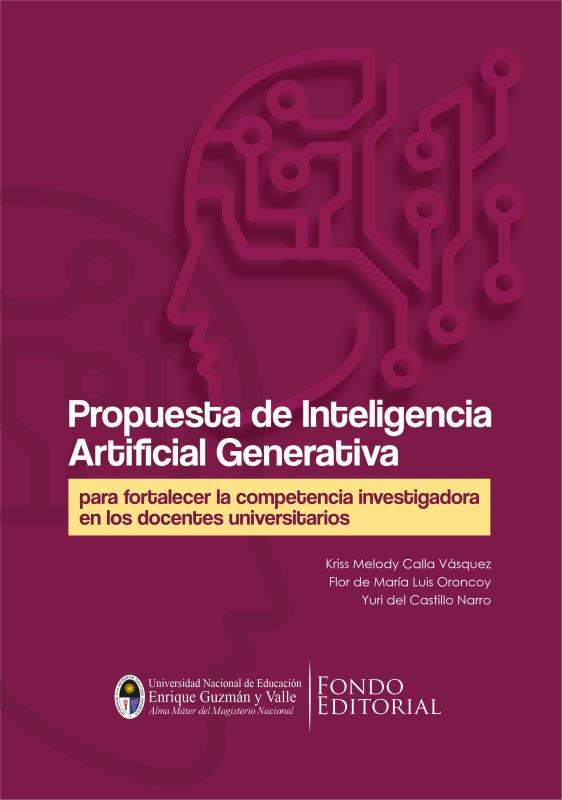
Propuesta de Inteligencia Artificial Generativa para fortalecer la competencia investigadora en los docentes universitarios
Sinopsis
Vivimos en una era donde la tecnología redefine, a una velocidad vertiginosa, los procesos de enseñanza, aprendizaje e investiga
ción. En este contexto, la inteligencia artificial generativa (IAG)
no solo representa una herramienta emergente, sino que constituye una autén tica oportunidad para transformar la manera en que los docentes universitarios acceden, gestionan y producen conocimiento. Frente a los desafíos que enfrenta la educación superior en América Latina, como la escasa producción científica, la sobrecarga docente, las brechas tecnológicas y la limitada formación investigativa, surge la necesidad de replantear nuestras prácticas formativas e investigadoras con una mirada crítica, innovadora y propositiva; una perspectiva crítica, innovadora y orientada a la solución.
Capítulos
-
Capítulo I: Fundamentos teóricos de la competencia investigadora docente .
-
Capítulo II: Inteligencia artificial generativa y su rol en la educación
-
Capítulo III: Revisión de antecedentes científicos
-
Capítulo IV: Propuesta formativa basada en IA generativa
-
Capítulo V: Talleres de formación en IA generativa para la investigación docente
-
Capítulo VI: Consideraciones para la implementación institucional
Referencias
Capítulo I
Fundamentos teóricos de la competencia investigadora docente
Bernal, C. A. (2010). Metodología de la investigación (3.ª ed.). Pearson Educa
ción.
Blömeke, S., Jentsch, A., & Kaiser, G. (2022). Teacher competence, instructional quality, and students’ learning progression. Learning and Instruction, 80, 101613. https://doi.org/10.1016/j.learninstruc.2022.101613
Bolívar, A. (2005). La investigación educativa: una competencia clave en la
formación docente. Revista de Educación, (337), 105–134.
Buchholtz, N. (2023). The evolution of research on teacher competencies, knowledge and skills. En The Evolution of Research on Mathematics Teachers’… [Capítulo]. Springer. https://doi.org/10.1007/978-3-031-31193-2_3
Canniffe, D. (2025). What is ‘research led teaching’ and how can we deliver it in higher education? Journal of Further and Higher Education. https://doi.or
g/10.1080/00219266.2024.2351389
Cardoza Sernaqué, M. A., Camacho, L. M., Collazos Alarcón, M. A., García
Farías, V. A., Bellido Valdiviezo, O., & Turriate Chávez, J. J. (2023). Development of research competences in university professors: A bibliographic review. International Journal of Multidisciplinary Science and Technology, 10(3), 1750–1755. https://doi.org/10.11573/ijmst.v10i3.1790 Chan, C. K. Y., Hu, W., &
Luke, B. (2023). A comprehensive AI policy education framework for university teaching and learning. International Journal of Educational Technology in Higher Education, 20(1), 56. https://doi.org/10.1186/s41239-023-00408-3 Comisión Europea. (2023). European Competence Framework for Researchers [Presentación].
Cotton, D. R. E., Cotton, P. A., & Shipway, J. R. (2024). Chatting and cheating:
Ensuring academic integrity in the era of ChatGPT. Teaching in Higher Edu
cation, 29(5), 790–803. https://doi.org/10.1080/14703297.2023.2190148
Dervenis, C., & Fitsilis, P. (2021). A review of research on teacher competencies in higher education. Quality Assurance in Education.
Díaz, F., & Hernández, G. (2011). Estrategias docentes para un aprendizaje
significativo: una interpretación constructivista. McGraw-Hill. 20 | Propuesta de IAG para fortalecer la competencia investigadora en los docentes universitarios
Escudero, T. (2012). La competencia investigadora: Un reto para la formación
del profesorado universitario. Profesorado: Revista de Currículum y For
mación del Profesorado, 16(1), 13–27.
García, A., & Mendoza, H. (2020). Competencia investigativa en la docencia
universitaria: avances y desafíos. Revista Electrónica Educare, 24(3), 1–20.
https://doi.org/10.15359/ree.24-3.18
González Díaz, R. (2022). Latin American professors’ research culture in the
digital age. Education Journal.
Gussen, L. (2023). Supporting pre-service teachers in developing research competence: Flexible online modules as a promising approach. Frontiers in
Education. https://doi.org/10.3389/feduc.2023.1197938
Hernández, R. M., Saavedra López, M. A., Rojas Pisfil, M., La Rosa Feijoó, O.
C., & Mejía Benavides, A. (2024). University social responsibility as part of
sustainable development in Latin America: A study of scientific production
in the last 20 years. Acta Innovations, 51, 36–45.
Jones, E. A., Lane, A. K., Goforth, M., & Vandermorris, A. (2024). Development
and validation of the Sources of Research Self-Efficacy (SRSE) scale. Educa
tional and Psychological Measurement, 84(7–8), 1667–1694. https://doi.
org/10.1177/07342829231204507
Koz, O., Yilmaz, R. M., & Sari, S. (2021). Building research capacity through
an academic community of practice: A longitudinal design case. Journal
of Applied Research in Higher Education, 13(4), 1148–1165. https://doi.
org/10.1108/JARHE-05-2019-0126
Mitchell, K. M., McMillan, D. E., & Lobchuk, M. (2021). Development and
validation of the Situated Academic Writing Self-Efficacy Scale (SAWSES).
Learning and Individual Differences, 90, 102045. https://doi.org/10.1016/j.
lindif.2021.102045
Pozo, J. I., & Monereo, C. (2009). Competencias para aprender: la perspectiva
de los contenidos escolares. Graó.
Ramírez, F. (2018). La investigación en la educación superior: Retos y perspec
tivas. Editorial UPN. RfHE (Radio psic Educación continua). (2024). Research informed teaching practice in continuing higher education. International Research in Higher Education, 10(1), 11–24. https://doi.org/10.5430/irhe.v10n1p11
Propuesta de IAG para fortalecer la competencia investigadora en los docentes universitarios | 21
Rodríguez, G., Gil, J., & García, E. (1996). Metodología de la investigación cua
litativa. Aljibe.
Salas, M. A. (2021). Diagnóstico de la competencia investigadora en docentes
universitarios de Lima Metropolitana. Revista de Investigación Educativa,
39(2), 234–251.
Smestad, B., Monkejord, A., & Krumsvik, R. J. (2023). Examining dimensions
of teachers’ digital competence before and during COVID-19: A review.
Education and Information Technologies, 28, 12315–12340. https://doi.
org/10.1007/s10639-023-11669-7
Srivastava, K., & Prakasha, G. S. (2024). Influence of organization ethos on re
search competence of teachers in higher education institutions. International
Journal of Evaluation and Research in Education, 13(5), 3185–3193. https://
doi.org/10.11591/ijere.v13i5.28652
Tondeur, J., Aesaert, K., Siddiq, F., & van Braak, J. (2023). The HeDiCom
framework: Higher education teachers’ digital competencies. Education
and Information Technologies, 28, 1043–1066. https://doi.org/10.1007/
s10639-022-11035-7
UNESCO. (2021). Replantear nuestras formas de ser humanos: Hacia un nuevo contrato social para la educación. https://unesdoc.unesco.org/ark:/48223/
pf0000379707_spa
Van Dijk, E. E., van Tartwijk, J., van der Schaaf, M., & Kluijtmans, M. (2020).
What makes an expert university teacher? A systematic review and synthesis
of frameworks for teacher expertise in higher education. Educational Re
search Review, 31, 100365. https://doi.org/10.1016/j.edurev.2020.100365
Vitae. (2023). Researcher Development Framework Handbook. University of
Galway.
Zhao, Y., Pinto-Llorente, A. M., & Sánchez-Gómez, M. C. (2021). Digital com
petence in higher education research: A systematic review. Computers &
Education, 168, 104212. https://doi.org/10.1016/j.compedu.2021.104212
Capítulo II
Inteligencia artificial generativa y su rol en la educación
Bender, E. M., Gebru, T., McMillan-Major, A., & Shmitchell, S. (2021). On the
dangers of stochastic parrots: Can language models be too big? Proceedings
of the 2021 ACM Conference on Fairness, Accountability, and Transparency
(FAccT ’21), 610–623. https://doi.org/10.1145/3442188.3445922
Bengio, Y. (2021). Deep learning and the future of AI. Communications of the
ACM, 64(9), 58–65. https://doi.org/10.1145/3454122
Bengio, Y. (2021). Deep learning for AI. Communications of the ACM, 64(7),
58–65. https://doi.org/10.1145/3448250
Bengio, Y. (2021). The ethical imperative of explainable AI. Nature Machine
Intelligence, 3(11), 915–916. https://doi.org/10.1038/s42256-021-00424-y
Bommasani, R., Hudson, D. A., Adeli, E., Altman, R., Arora, S., von Arx, S.,
Bernstein, M. S., Bohg, J., Bosselut, A., Brunskill, E., Brynjolfsson, E.,
Buch, S., Card, D., Castellon, R., Chatterji, N., Chen, A., Creel, K., Davis,
J. Q., Demszky, D., … Liang, P. (2022). On the opportunities and risks of
foundation models. Journal of Machine Learning Research, 23(1), 1–199.
https://www.jmlr.org/papers/v23/21-1418.html
Cabero-Almenara, J., Romero-Tena, R., & Barroso-Osuna, J. (2023). Generative
artificial intelligence in higher education: Opportunities and challenges.
Education and Information Technologies, 28, 12645–12666. https://doi.
org/10.1007/s10639-023-11934-0
Chan, C. K. Y., Hu, W., & Luke, B. (2023). A comprehensive AI policy education
framework for university teaching and learning. International Journal
of Educational Technology in Higher Education, 20(1), 56. https://doi.
org/10.1186/s41239-023-00408-3
Cotton, D. R. E., Cotton, P. A., & Shipway, J. R. (2024). Chatting and cheating:
Ensuring academic integrity in the era of ChatGPT. Teaching in Higher Edu
cation, 29(5), 790–803. https://doi.org/10.1080/14703297.2023.2190148
Dwivedi, Y. K., Kshetri, N., Hughes, L., Slade, E. L., Javari, A., Kar, A. K.,
Baabdullah, A. M., Koohang, A., Paschen, J., Ahuja, V., Albanna, H.,
Albashrawi, M., Al-Busaidi, A. S., Balakrishnan, J., Bunker, D., Cannoy,
S., Carter, L., Chowdhury, S., … Wright, R. (2023). “So what if ChatGPT
wrote it?” Multidisciplinary perspectives on opportunities, challenges and
implications of generative AI for research, practice and policy. International
Propuesta de IAG para fortalecer la competencia investigadora en los docentes universitarios | 33 Journal of Information Management, 71, 102642. https://doi.org/10.1016/j.ijinfomgt.2023.102642
European Union. (2024). Reglamento (UE) 2024/1689 del Parlamento Europeo
y del Consejo, de 13 de junio de 2024, por el que se establecen normas
armonizadas en materia de inteligencia artificial (AI Act). Diario Oficial
de la Unión Europea. https://eur-lex.europa.eu/eli/reg/2024/1689/oj
González, M., & Morales, A. (2023). Uso de la inteligencia artificial generativa
en universidades latinoamericanas: avances y desafíos. Revista Latinoa
mericana de Tecnología Educativa, 22(1), 33–48.
Holmes, W., Bialik, M., & Fadel, C. (2022). Artificial intelligence in education:
Promises and implications for teaching and learning (2nd ed.). Center for
Curriculum Redesign.
Iriarte, F., Muñoz, C., & Cárdenas, J. (2023). Bias and fairness in large language models: Implications for education. Computers & Education: Artificial Intelligence, 4, 100117. https://doi.org/10.1016/j.caeai.2023.100117
Kasneci, E., Sessler, K., Küchemann, S., Bannert, M., Dementieva, D., Fischer,
F., Götz, G., Grunschel, C., Hüllermeier, E., Kasneci, S., Krzikalla, F., Mi
chaeli, T., Nerantzi, C., Pfeffer, C., Rausch, A., Renner, B., Röhl, T., Salden,
T., … Kasneci, G. (2023). ChatGPT for good? On opportunities and cha
llenges of large language models for education. Learning and Individual
Differences, 103, 102274. https://doi.org/10.1016/j.lindif.2023.102274
Khan, N., Siddiqui, M. F., & Alshamrani, A. (2023). Generative AI: Archi
tecture, applications, and challenges. Artificial Intelligence Review, 56,
11031–11067. https://doi.org/10.1007/s10462-023-10494-6
Luckin, R., Holmes, W., Griffiths, M., & Forcier, L. B. (2022). Intelligence un
leashed: An argument for AI in education. Pearson.
Nature Editorial. (2023). Tools such as ChatGPT threaten transparent science;
here are our ground rules for their use. Nature, 613, 612. https://doi.
org/10.1038/d41586-023-00191-1
OpenAI. (2023). GPT-4 technical report. https://openai.com/research/gpt-4
Pérez, D., & Torres, J. (2022). Evaluación crítica del contenido generado por IA
en español: retos y limitaciones. Revista Latinoamericana de Educación
y Tecnología, 10(2), 54–68.34 | Propuesta de IAG para fortalecer la competencia investigadora en los docentes universitarios
Russell, S. (2022). Human compatible: Artificial intelligence and the problem of control. Penguin Books.
Russell, S., & Norvig, P. (2021). Artificial intelligence: A modern approach (4th
ed.). Pearson.
Selwyn, N. (2023). AI in education: The importance of regulation and ethics.
Learning, Media and Technology, 48(3), 237–250. https://doi.org/10.108
0/17439884.2023.2178252
Selwyn, N. (2023). Should robots replace teachers? AI and the future of education. Polity Press. UNESCO. (2023). Guidance for generative AI in education and research. https://www.unesco.org/en/articles/guidance-generative-ai
UNESCO. (2023). Recomendación sobre la ética de la inteligencia artificial. https://unesdoc.unesco.org/ark:/48223/pf0000381137
Unión Europea. (2024). Reglamento (UE) 2024/1689 del Parlamento Europeo
y del Consejo, de 13 de junio de 2024, por el que se establecen normas
armonizadas en materia de inteligencia artificial (AI Act). Diario Oficial
de la Unión Europea. https://eur-lex.europa.eu/eli/reg/2024/1689/oj
Vaswani, A., Shazeer, N., Parmar, N., Uszkoreit, J., Jones, L., Gomez, A. N.,
Kaiser, Ł., & Polosukhin, I. (2017). Attention is all you need. Advances
in Neural Information Processing Systems, 30. https://doi.org/10.48550/
arXiv.1706.03762
Capítulo III
Revisión de antecedentes científicos
Acar, O. A. (2024, 19 de febrero). Generative AI opens up vast opportunities for education. World Economic Forum. https://www.weforum.org/agen
da/2024/02/generative-ai-opportunities-education/
Batista, J., Mesquita, A., & Carnaz, G. (2024). Generative AI and higher educa
tion: Trends, challenges, and future directions from a systematic literature
review. Information, 15(11), 676. https://doi.org/10.3390/info15110676
Bernilla Rodríguez, E. B. (2024). Docentes ante la inteligencia artificial en una
universidad pública del norte del Perú. Educación, 33(64), 8–28. https://
doi.org/10.18800/educacion.202401.M001
Fernández-Bringas, T., & Chinchay Pajuelo, A. S. (2023). Competencia digital
de información e inteligencia artificial en docentes universitarios en el
Perú: Retos de la pospandemia. En Blanco y Negro, 14(1), 1–10. https://
revistas.pucp.edu.pe/index.php/enblancoynegro/article/view/28188
Franganillo, J. (2023). La inteligencia artificial generativa y su impacto en
la creación de contenidos mediáticos. Methaodos: Revista de Ciencias
Sociales, 11(2), m231102a10. https://doi.org/10.17502/mrcs.v11i2.710
Galli, M. G., & Kanobel, M. C. (2023). ChatGPT en Educación Superior: Explo
rando sus potencialidades y sus limitaciones. Revista Educación Superior
y Sociedad (ESS), 35(2), 174–195. https://doi.org/10.54674/ess.v35i2.815
Gallent-Torres, C., Zapata-González, A., & Ortego-Hernando, J. L. (2023).
The impact of generative artificial intelligence in higher education: A fo
cus on ethics and academic integrity. RELIEVE, 29(2), M5. https://doi.
org/10.30827/relieve.v29i2.29134
McDonald, N., Johri, A., Ali, A., & Hingle, A. (2024). Generative artificial intelli
gence in higher education: Evidence from an analysis of institutional policies
and guidelines (arXiv:2402.01659). arXiv. https://arxiv.org/abs/2402.01659
Solís, M. E. (2023). Inteligencia artificial generativa para fortalecer la educación superior. LatAM Revista Latinoamericana de Ciencias Sociales y Humanidades, 4(3), 767–780. https://doi.org/10.56712/latam.v4i3.1113
Vera-Rubio, P. E., Bonilla González, G. P., Quishpe Salcán, A. C., & Campos
Yedra, H. M. (2023). La inteligencia artificial en la educación superior: Un
enfoque transformador. Polo del Conocimiento, 8(11), 390–411. https://
doi.org/10.23857/pc.v8i11.6193
Capítulo IV
Propuesta formativa basada en IA generativa
Ausubel, D. P. (2002). Adquisición y retención del conocimiento: Una perspectiva cognitiva. Paidós. Bengio, Y. (2021). Deep learning for AI. Communications of the ACM, 64(7), 58–65. https://doi.org/10.1145/3448250
Brookfield, S. D. (2017). Becoming a critically reflective teacher. John Wiley &
Sons.
Fernández-Bringas, T., & Chinchay, A. (2023). Competencia digital de informa
ción e inteligencia artificial en docentes universitarios en el Perú: Retos
de la pospandemia. Revista Educación Superior y Sociedad, 35(2), 45–67.
Gallent-Torres, C., Zapata-González, A., & Ortego-Hernando, J. L. (2023). El
impacto de la inteligencia artificial generativa en educación superior: Una
mirada desde la ética y la integridad académica. Revista Iberoamericana
de Educación, 91(1), 25–46.
Holmes, W., Bialik, M., & Fadel, C. (2022). Artificial intelligence in education:
Promises and implications for teaching and learning. Center for Curriculum
Redesign.
Ramírez, M. A. (2024). La incorporación de la inteligencia artificial en el de
sarrollo de competencias investigadoras en los docentes universitarios.
Revista Peruana de Educación, 14(1), 85–102.
Tobón, S. (2013). Formación integral y competencias. ECOE Ediciones.
UNESCO. (2023). Recomendación sobre la ética de la inteligencia artificial.
https://unesdoc.unesco.org/ark:/48223/pf000038113
Capítulo VI
Consideraciones para la implementación institucional
Batista, J., Mesquita, A., & Carnaz, G. (2024). Revisión sistemática sobre el im
pacto de GAI en la educación superior. Education and Information Tech
nologies, 29(3), 2331–2350. https://doi.org/10.1007/s10639-023-11934-0
Bommasani, R., Hudson, D. A., Adeli, E., Altman, R., Arora, S., von Arx, S., ...
& Liang, P. (2022). On the opportunities and risks of foundation models.
Journal of Machine Learning Research, 23(1), 1–199. https://www.jmlr.
org/papers/v23/21-1418.html
Canniffe, D. (2025). What is ‘research-led teaching’ and how can we deliver it in
higher education? Journal of Further and Higher Education. https://doi.
org/10.1080/00219266.2024.2351389
Chan, C. K. Y., Hu, W., & Luke, B. (2023). A comprehensive AI policy education
framework for university teaching and learning. International Journal
of Educational Technology in Higher Education, 20(1), 56. https://doi.
org/10.1186/s41239-023-00408-3
Cotton, D. R. E., Cotton, P. A., & Shipway, J. R. (2024). Chatting and cheating:
Ensuring academic integrity in the era of ChatGPT. Teaching in Higher
Education, 29(5), 790–803. https://doi.org/10.1080/14703297.2023.2190148
European Union. (2024). Reglamento (UE) 2024/1689 del Parlamento Europeo
y del Consejo, de 13 de junio de 2024, por el que se establecen normas
armonizadas en materia de inteligencia artificial (AI Act). Diario Oficial
de la Unión Europea. https://eur-lex.europa.eu/eli/reg/2024/1689/oj
Gutiérrez, F. J. (2024). Uso de inteligencia artificial generativa para la mejora
de las competencias docentes en investigación. Revista Latinoamericana
de Tecnología Educativa, 23(1), 55–72.
Koz, O., Yilmaz, R. M., & Sari, S. (2021). Building research capacity through
an academic community of practice: A longitudinal design case. Journal
of Applied Research in Higher Education, 13(4), 1148–1165. https://doi.
org/10.1108/JARHE-05-2019-0126
Luckin, R., Holmes, W., Griffiths, M., & Forcier, L. B. (2022). Intelligence un
leashed: An argument for AI in education. Pearson Education.
Nature Editorial. (2023). Tools such as ChatGPT threaten transparent science;
here are our ground rules for their use. Nature, 613(7944), 612. https://
doi.org/10.1038/d41586-023-00191-1
Propuesta de IAG para fortalecer la competencia investigadora en los docentes universitarios | 71
Srivastava, K., & Prakasha, G. S. (2024). Influence of organization ethos on
research competence of teachers in higher education institutions. Interna
tional Journal of Evaluation and Research in Education, 13(5), 3185–3193.
https://doi.org/10.11591/ijere.v13i5.28652
UNESCO. (2023). Guidance for generative AI in education and research. https://
www.unesco.org/en/articles/guidance-generative-ai
UNESCO, Miao, F., & Holmes, W. (2023). Orientaciones para la inteligencia
artificial generativa en la educación y la investigación. UNESCO. Recu
perado de https://policycommons.net/artifacts/6942367/guidance-for
generative-ai-in-education-and-research/7852269/
Descargas
Publicado
marzo 25, 2026
Derechos de autor 2026 Kriss Melody Calla Vásquez, Flor de María Luis Oroncoy, Yuri del Castillo Narro (Autor/a)
Licencia

Esta obra está bajo una licencia internacional Creative Commons Atribución-NoComercial-SinDerivadas 4.0.
Detalles sobre esta monografía
ISBN-13 (15)
978-612-4148-77-4
Cómo citar
Propuesta de Inteligencia Artificial Generativa para fortalecer la competencia investigadora en los docentes universitarios. (2026). Fondo Editorial La Cantuta. https://doi.org/10.54942/lacantuta.59